The American Estate Planning Crisis: Why Death Shouldn’t Require a Law Degree
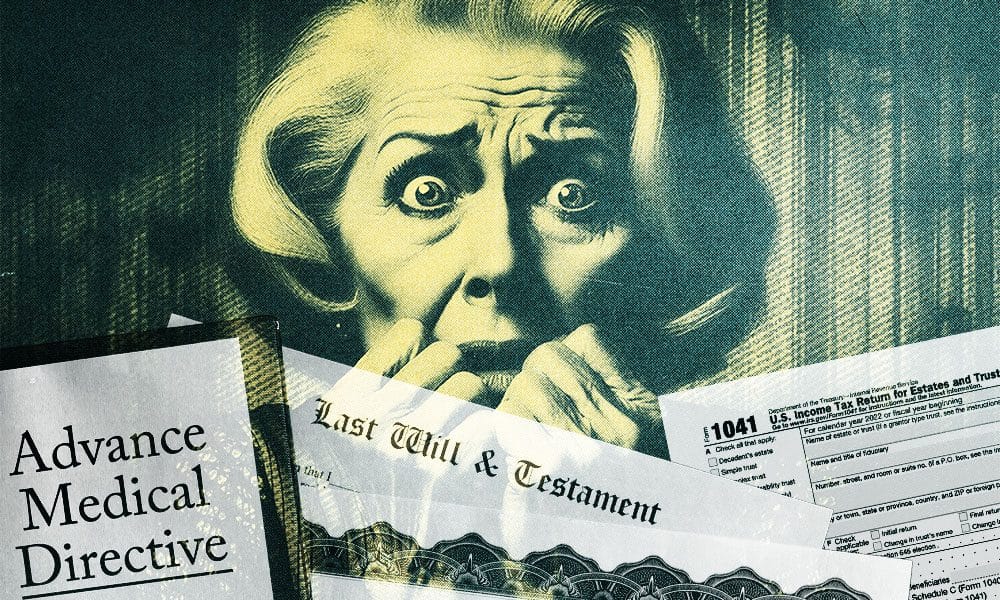 Picture this: Your parent is dying. You’re sleeping in hospital chairs, making impossible medical decisions, watching them fade. Then they’re gone. You think the hardest part is over.
You’re wrong.
Welcome to America’s estate planning nightmare—a byzantine system that transforms grieving families into amateur paralegals, forcing them to navigate a maze of documents, deadlines and bureaucratic obstacles at the worst possible moment in their lives.
The Documentation Disaster
The current system is nothing short of insanity. A person serving as durable power of attorney needs an entire filing cabinet worth of documents just to handle basic responsibilities. Bank statements require death certificates. Insurance companies demand probate documents. Healthcare facilities need advance directives. Social Security wants forms that overlap with Veterans Affairs forms that conflict with Medicare forms.
Each institution has its own requirements, its own timeline, its own special way of making an already devastating situation exponentially worse. You’ll make seventeen trips to the bank, each time being told you need “just one more document.” You’ll spend hours on hold with agencies that close at 4 PM—exactly when you get off work from the job you can’t afford to lose while settling these affairs.
Here’s what makes this particularly cruel: the very people most equipped to handle these responsibilities—those who cared for their loved ones, who know their wishes, who held power of attorney—are treated with suspicion at every turn. Financial institutions act like you’re trying to steal from the person you just spent months caring for. Government agencies require proof of things they already have on file. The system punishes responsibility.
Real People, Real Nightmares
Consider the daughter who took six months off work to care for her father with dementia. She managed his medications, coordinated with doctors, handled his finances under power of attorney. When he died, she discovered that the POA she’d been using was “wrong” for three of his four bank accounts. Despite having court-appointed authority, she couldn’t access funds to pay for his funeral without going through probate—a process that took eight months and $12,000 in legal fees.
Or the son who discovered his mother’s modest estate required documents from her divorce in 1987—papers destroyed in a basement flood years ago. The court demanded proof of something that no longer existed, creating a legal catch-22 that took a year to resolve.
These aren’t edge cases. They’re Tuesday in America’s probate courts.
The Three-Document Solution
Here’s the infuriating part: we have the technology and legal framework to fix this. We simply choose not to.
Imagine a world where every American adult is required by law to maintain three documents:
1. A Comprehensive Living Trust Not the expensive, attorney-only version that costs thousands. A standardized, adaptable trust that serves as the master document for both healthcare and wealth distribution. This document would be registered with a federal database, accessible to authorized parties upon death or incapacitation. It would include:
- Asset distribution instructions
- Healthcare directives
- Burial preferences
- Digital asset management
- Dependent care instructions
2. A Universal Durable Power of Attorney One document, recognized by every financial institution, healthcare facility and government agency in the country. No more arguing about whether your POA is “their” approved version. No more multiple documents for different purposes. One form, federal backing, universal acceptance.
3. A National Death Certificate Currently, death certificates are issued by states, counties, even cities—each with different formats, processing times and requirements. A single, federally-issued digital death certificate would eliminate the need for multiple certified copies, reduce fraud and accelerate the settlement process.
Making It Mandatory (And Accessible)
Here’s where people will scream about government overreach: make it mandatory. At age 18, every American completes basic estate planning documents, just like registering for selective service. Update them with major life events—marriage, divorce, children, property purchases.
But mandatory doesn’t mean expensive. These documents would be:
- Free to create through a government portal
- Written in plain English, not legalese
- Updated easily online
- Automatically reviewed every five years
- Accessible to designated parties through secure digital verification
The IRS knows every dollar you earn. The DMV tracks every vehicle you own. Social Security follows you from birth to death. Yet somehow, when you die, your family has to prove you existed, owned things and had the right to distribute them. It’s absurd.
The Cost of Inaction
Our current system costs families billions annually in legal fees, lost productivity and unnecessary complications. It particularly punishes the middle class—those with enough assets to require probate but not enough to afford extensive legal planning. It devastates families already dealing with grief, forcing them to choose between properly settling estates and maintaining their own financial stability.
This isn’t about creating more bureaucracy. It’s about demolishing the bureaucracy that turns death into a part-time job for survivors. It’s about recognizing that in 2024, we can do better than a system designed for the 1800s.
The Path Forward
Reform starts with recognition: our current estate planning system is broken, cruel and unnecessarily complex. It continues with demands for change at the state and federal level. Every horror story, every family destroyed by probate costs, every person who couldn’t afford their parent’s funeral because accounts were frozen—these are policy failures, not personal ones.
Write to your representatives. Share your stories. Demand a system that treats grieving families with dignity, not suspicion. Demand recognition that the person who cared for someone in life is probably not trying to rob them in death.
Death is hard enough. The paperwork shouldn’t be harder.
The three-document solution isn’t just possible—it’s overdue. Until we demand better, we’re all just one death away from discovering exactly how broken this system really is.
Leave a Reply
You must be logged in to post a comment.